
We suggest the best route and the best ideas for what to see and do in Segovia in two days.
Two days is the perfect amount of time to enjoy this wonderful city and discover everything the ancient Roman city has to offer.
If you want to plan your visit even better and get to know all the city’s secret corners, its best monuments, what and where to eat, the best tapas route in Segovia, where to sleep, the best panoramic viewpoints, how to get there, where to park your car and much more, we suggest you download Secrets of Segovia (in Spanish), a free 80-page guide full of all the information you need to plan your getaway.
Day one of the route: what to see and do in Segovia
Check-in time at most accommodation in Segovia is 14:00. If you arrive earlier and need to leave your luggage, hotels usually have no problem keeping it at reception while you set off to explore the city.
Two days is the perfect time for Segovia to become one of the best memories of your life. And it is right here, close to home. Let’s get going. The first day of our route is dedicated to the most important monuments of the walled city.

A. Plaza del Azoguejo
Start your walk from Plaza del Azoguejo, with the aqueduct welcoming you. The tourist information office is right next to the aqueduct in case you need to ask anything.
Segovia’s aqueduct is the most peculiar and spectacular historic construction in Segovia and the best-preserved Roman engineering work in Spain. It is the city’s most iconic building and should be one of your priorities when planning what to see and do in Segovia in two days.
The aqueduct must be your priority when deciding what to see and do in Segovia in two days. There is no other like it in the world.
Historical facts about the Segovia aqueduct
It was built by the Roman Empire between the 1st and 2nd centuries. Its exact date of construction is unknown. Some historians date it to AD 97, while others maintain it was a little later, around AD 108.
It corresponds to the era of the emperors Hadrian and Trajan.
Why such a grand construction? To supply water to the Segovia neighbourhoods near the Alcázar of Segovia.
The project of carrying water from the Riofrío river to Segovia was not too complex, as the 16 km route is relatively flat.
The engineers ran into a problem on reaching what was then the outskirts of the city: crossing the terrain formed by the Vado de los Clamores (today’s Plaza del Azoguejo) and connecting with the city on the rocky heights.
To solve this problem it was decided to build the structure of arches.
Technical facts about the Segovia aqueduct
The Roman Aqueduct of Segovia measures a total of 16,222 metres.
It starts in the village of Riofrío and covers this entire distance with a constant 1% downward slope that keeps the water at a suitable speed and flow along its whole route.
The water is carried in a 30×30 cm channel at the top of the aqueduct.
This remarkable hydraulic work includes several structures along its route to reduce the amount of sand in the water and make it more drinkable.
Its most spectacular section, the one that appears in every photo, is 813 metres long, has 167 arches and a maximum height of 28 metres.
25,000 blocks of stone, carved by hand, were used to build it.
Each one was carved to measure for a specific place in the structure.
The Roman engineers used no cement of any kind. The aqueduct stands thanks to the perfect alignment of its stone blocks. A real challenge to gravity!
B. Casa de los Picos
Calle Cervantes is one of the busiest streets in Segovia. Follow it until you reach the Casa de los Picos.

It is one of the most unusual buildings in Segovia because of the 360 spikes that decorate its façade.
It is on Calle Juan Bravo and was built in the late 15th century in a Jewish style.
It belonged to Pedro López de Ayala. The house was known as the House of the Jew.
His son Pedro sold it to Juan de la Hoz, who decided to alter the façade and had the 360 spikes built so that the property would lose the Jewish style it was originally designed with.
It came to be called the Casa de los Picos (House of the Spikes).
Another theory links the origin of the spikes to the building’s old location. The San Miguel Gate (one of the gates of Segovia’s city wall) stood right in front of the Casa de los Picos.
Its peculiar decoration with spikes, closer to a medieval style, was meant to show intruders that the city was heavily protected.
Today the Casa de los Picos is home to the Segovia School of Applied Arts.
Inside, the small elbow-shaped courtyard stands out, designed to guarantee its inhabitants’ privacy. Entry is free.
C. Old grain store
Continue along Calle Juan Bravo and turn left onto Calle Alhóndiga for a quick visit to the building that was used as Segovia’s grain store.

D. Plaza de Medina del Campo
Return to Calle Juan Bravo and continue to the Plaza de Medina del Campo, where you can visit the Church of San Martín, the Torreón de Lozoya and the old prison.

In the heart of the old town, next to Calle Real, the Plaza de Medina del Campo lies halfway between the aqueduct and the Alcázar.
It is one of the best examples of medieval architecture. The church was built in the 12th century in the San Fermín neighbourhood, which enjoyed a great economic boom at that time. The palaces built around the church, such as the Torre de Lozoya and the Casa de Parra, are proof of this.
The surroundings of the Plaza de Medina del Campo are among the most charming in the whole old town. The square oozes history from every corner. Today it is full of cafés where you can rest and take in the wonderful setting.
If you can visit it at night, don’t hesitate: it has an even more incredible character.
The interior of the Church of San Martín houses altarpieces, atriums, sculptures and paintings of great value.
In the centre of the square stands a statue honouring one of the leaders of the Comuneros revolt: Juan Bravo.
E. Plaza Mayor of Segovia
We arrive at the Plaza Mayor. On your left, imposing, rises the Lady of Cathedrals. A must when you are planning what to see and do in Segovia in two days.

If the outside is impressive, the inside is no less so. Don’t hesitate to visit it.
It is known as the Lady of Cathedrals for its slender lines and singular beauty.
It was built in 1525, replacing the remains of the earlier cathedral, which was destroyed during the War of the Communities.
The original cathedral stood next to the Alcázar and was used as a bastion by the Comuneros to protect themselves from the attacks of King Charles I’s troops.
It is Gothic in style and stands out for its pinnacles and for the size of its tower, which is still the tallest building in Segovia.
The official website of Segovia Cathedral is: http://www.catedralsegovia.es
F. Canonjías neighbourhood
Continue your visit with the Canonjías neighbourhood and the Arco de la Claustra
It is one of the spaces with the most interesting and curious history in Segovia.

It is next to the Alcázar, and as Segovia grew in the second half of the 15th century this part fell into oblivion because of the lack of land in this area of the city. The absence of new buildings has preserved in its original state one of the most important Romanesque neighbourhoods in Europe.
At the centre of the Canonjías neighbourhood stood the Church of San Miguel, right in front of the Alcázar, on the spot where the gardens are today.
During the War of the Communities, the Church of San Miguel was used as barracks by the Comunero troops fighting Charles I’s troops entrenched in the Alcázar.
Because of the war it suffered serious damage and, when the conflict ended, it was moved to its current location to prevent it from continuing to be used as a base of operations for attacking the castle.
The neighbourhood was the residence of the monks in charge of Segovia Cathedral. It had 3 gates that were closed at night; today only one survives, the Clausura Gate, and they were positioned so that the neighbourhood was triangular in shape.
The canon monks established a series of rules and laws exclusive to the neighbourhood. Notable among them:
- A ban on letting animals roam free
- A ban on beautiful women entering, so the monks would not be distracted
- Exemption from taxes for the residents of the neighbourhood
- Subject to the protection of the Bishop, obeying no law other than his
- Right of asylum. Anyone who reached the neighbourhood could request asylum to avoid being arrested by the authorities.
This last one, the right of asylum, was precisely one of the reasons the neighbourhood began to lose importance. After the War of the Communities, King Charles I ordered the removal of the neighbourhood’s gates and the dissolution of the order in order to prevent further revolts and the protection the monks gave to the Comuneros.
The buildings in Segovia’s Canonjías neighbourhood stand out for their spaciousness for the period in which they were built. They generally consist of 2 floors with an attic, an inner courtyard and a garden area at the back. They also had direct access to drinking water through channels connecting the houses with the aqueduct’s canal.
In one of the houses of the neighbourhood the first printed book in Spain was produced: the Sinodal de Aguilafuente.
Segovia Cathedral holds the only existing copy of this first book. The driving force behind it was the Bishop of Segovia, Juan Arias Dávila, who was keen to spread culture to all social classes and brought the German printer Johann Parix from Rome to set up a printing press here.
G. Alcázar of Segovia
Head towards the Alcázar. Visit the castle first and leave the climb up the Keep (Torre del Homenaje) for last.
It is one of the most important buildings on our list of things to see and do in Segovia in 2 days.

The Segovian castle was used by Walt Disney as inspiration for designing his Snow White castle. But its history goes back much further than the time of the wonderful illustrator. Stones of the same material as the aqueduct have been found, so historians believe some kind of fortification existed from Celtic or Roman times.
Historical facts about the Alcázar of Segovia
The first written reference to the Alcázar dates from 1155. Alcázar comes from the Arabic Al Qasr, meaning “the fortress”.
King Alfonso VII of Castile was the first to use the castle as his residence. Alfonso X the Wise also used it as a temporary residence and was the first to hold the Cortes of Castile there, between 1258 and 1278.
The Alcázar gradually became a very important centre of power in Castile and acquired great decorative richness between 1379 and 1474 under Kings John I and Henry IV.
Their successor was Queen Isabella the Catholic, who left the Alcázar to be crowned in the Church of San Miguel. During her reign, and as a consequence of the Comunero wars, Segovia gradually lost weight on the Castilian political map and the centre of power moved little by little to Madrid.
The construction of the Royal Palaces of El Escorial and Aranjuez dealt the final blow to the Alcázar, which was removed from the circle of main royal residences and fell into the background.
In 1764 King Charles III tried to revitalise Castile’s economy by creating an Artillery Regiment and School in the Alcázar. In March 1862 a fire destroyed almost all of the coffered ceilings and paintings, although they were later restored. After the fire it was turned into the military archive, a function it still serves today.
The Alcázar occupies a strategic position from a military point of view because of how hard it is to assault. It stands on a rocky promontory between the Eresma and Clamores rivers.
Things to note about the Alcázar of Segovia
It has a perimeter of 728 metres that adapts perfectly to the difficult terrain. Its original entrance was a drawbridge over a moat 26 metres deep.
Having undergone extensions and transformations over the centuries, its architecture contains very varied styles such as Mudéjar, Gothic, Romanesque and even Renaissance.
It is one of the most visited buildings in Spain and it does not disappoint. It does take time, though: allow about 2 hours for your visit.
A full ticket costs 8 euros, or 3.50 for under-16s.
The Alcázar of Segovia offers guided tours (in Spanish) lasting 45 minutes for an extra 2 euros. You can also visit on your own with an audio guide for an extra 3 euros.
The official website of the Alcázar of Segovia is: www.alcazardesegovia.com
Day two of the route: what to see and do in Segovia
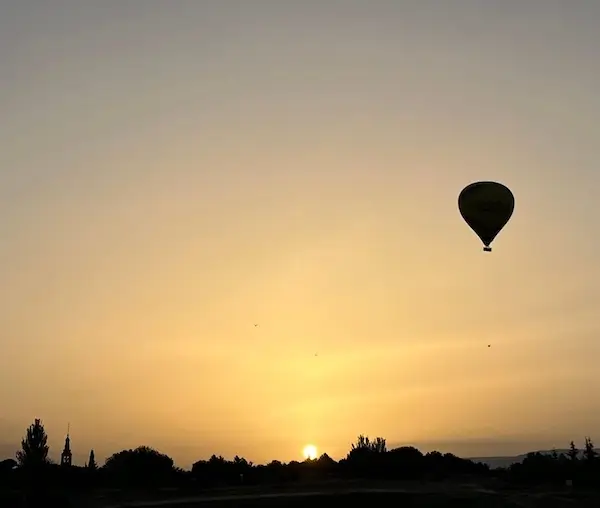
Start the day on a high with a hot air balloon flight over Segovia, considered one of the five best balloon flights in the world.
When you are planning what to see and do in Segovia in two days, the balloon flight should be your number one priority. There is no experience like it in all of Spain.

The hot air balloon flight over Segovia is rated the number 1 outdoor activity in Segovia according to Tripadvisor.
At EoloFLY we offer a free pick-up service from your hotel in Segovia. If you would like to stay in bed a little longer, we have a hotel and hot air balloon flight offer at the Hotel Corregidor, just 100 metres from the meeting point and about 500 metres’ walk from the most usual take-off area. No rush, no stress.
You can see all the hot air balloon flight options over Segovia here.
Once your flight adventure is over, we will start an outside-the-walls route that takes us along Segovia’s city wall and the valley of the Eresma river.
A. La Judería Educational Centre
Our walking route for the second day of your visit to Segovia starts in the Jewish quarter, at the La Judería educational centre (free entry for passengers of EoloFLY hot air balloon flights)

The first records of a Jewish presence in Segovia date from the 12th century, and they were concentrated mainly around the city’s commercial area. In 1480 Jews were obliged to live only in the neighbourhood we now know as the Judería.
In 1492, under the reign of Isabella the Catholic, the expulsion of the Jews from Spain was ordered. All those who did not agree to convert to Christianity left the peninsula forever.
At its height, the Jewish community had 5 synagogues in the centre of Segovia. Today only the Main Synagogue survives, converted into the Church of Corpus Christi.
The centre holds a large number of objects, information panels and audiovisual media that explain the great mark left by the Sephardic community in Segovia.
Entry costs 2 euros. All passengers on an EoloFLY hot air balloon flight over Segovia receive a free pass to visit the educational centre.
B. Segovia city wall and San Andrés Gate
Continue to Segovia’s city wall and visit the San Andrés Gate, which has been converted into a museum and is also home to a Segovia City Council tourist office.
Located in the Judería neighbourhood, it is one of the most spectacular gates in Segovia’s wall. Inside there is a Segovia City Council tourist information point where they will tell you about any aspect of the wall, and where you can visit a section of it.
The Tourist Information Centre offers an audio guide service for visiting the wall for 1.5 euros.

The San Andrés Gate was used by Jews to reach their cemetery, which was outside the city walls.
It was also the gate through which the Jews left the city of Segovia after the expulsion order in 1492. Built in the 11th century in Mudéjar style.
It is the ideal place to take a guided visit of the wall.
C. Pradera de San Marcos viewpoint
From the Hontanilla park starts the path that, skirting the wall, takes us along the Clamores Valley.
There are several viewpoints with views of the Alcázar and the Cathedral. You will reach one of the most spectacular viewpoints in Segovia, which you will have seen in countless photos. The Alcázar is shown in all its splendour from the Pradera de San Marcos viewpoint.

D. La Veracruz
Visit the Church of Vera Cruz, built by the Templars.

Just 300 metres from the Pradera de San Marcos, towards Zamarramala. From here we can enjoy very good views of the Alcázar, the city wall and Segovia Cathedral. The Vera Cruz church is well worth a visit in its own right.
It was built in 1208 by the Knights of the Order of the Holy Sepulchre. Its twelve-sided design is unique in Spain and is due to the fact that it was built in the likeness of the temples of Jerusalem. The church tower was not part of the original construction.
E. Zamarramala viewpoint
Continue towards the village of Zamarramala and enjoy a complete view of Segovia from its viewpoint.

F. Casa de la Moneda (Royal Mint)
Retrace your steps to the Eresma valley to visit the Casa de la Moneda (free entry for passengers on an EoloFLY hot air balloon flight). Next to the Casa de la Moneda you can stop at an Aqueduct interpretation centre, which explains everything about Segovia’s star monument.

The Segovia mint was built by King Philip II in 1583 to strike coins using industrial machinery for a faster and more efficient result.
It is considered the first mechanised mint in Spain and the first that belonged to the Crown. The hydraulic machinery custom-built by the architect Juan de Herrera stands out.
G. Segovia outside-the-walls route
Find the Paseo de la Alameda and follow the path that runs parallel to the Eresma River. Cross the Puente de la Alameda and join the Paseo de Santo Domingo de Guzmán, which will take you straight to the Plaza del Azoguejo.

What better place to end your visit to Segovia than the iconic Aqueduct. There are a thousand ways to discover Segovia, so we invite you to download our tourist guide Secrets of Segovia (in Spanish) for more ideas and inspiration on what to see and do in Segovia in two days.
Segovia will make you fall in love. Enjoy it.
You may also be interested in:
Where to find the best views of Segovia